
Published on November 11, 2026
General corporate income tax rate.
The general income tax rate applicable to domestic companies and assimilated entities, permanent establishments, and foreign legal entities required to file income tax returns in Colombia, will decrease from 35% to 33% in 2027 and to 31% from 2028 onwards.
Surtax on the financial sector.
A 5% surtax will remain in effect for financial institutions, insurance and reinsurance companies, securities and agricultural commodity brokers, commodity and product exchanges, and securities market infrastructure providers whose taxable income equals or exceeds 120,000 Tax Value Units (UVT) (COP 6,284,880,000/ USD 1.922.040, 42) in 2026).
The surtax will be paid in advance in two semiannual installments.
Minimum tax rate.
The minimum tax rate under paragraph 6 of Article 240 of the Colombian Tax Code will be limited to controlling entities of multinational groups resident in Colombia and to subsidiaries, branches, or permanent establishments located in Colombia belonging to domestic or foreign multinational groups, provided that the group earned consolidated revenue of at least EUR 750 million in the preceding period, according to the controlling entity’s financial statements. Earnings will be converted into Colombian pesos or to the local currency of the controlling entity’s country of residence, as applicable, using the average exchange rate for the preceding December.
Unified Regime for Business Stability (RUGE).
RUGE proposes tax and customs incentives and legal stability for qualifying domestic or foreign productive investments made by individuals or legal entities. In public-private partnerships, the investors are the partners or shareholders of the Special Purpose Vehicle.
Minimum investment amounts by sector:
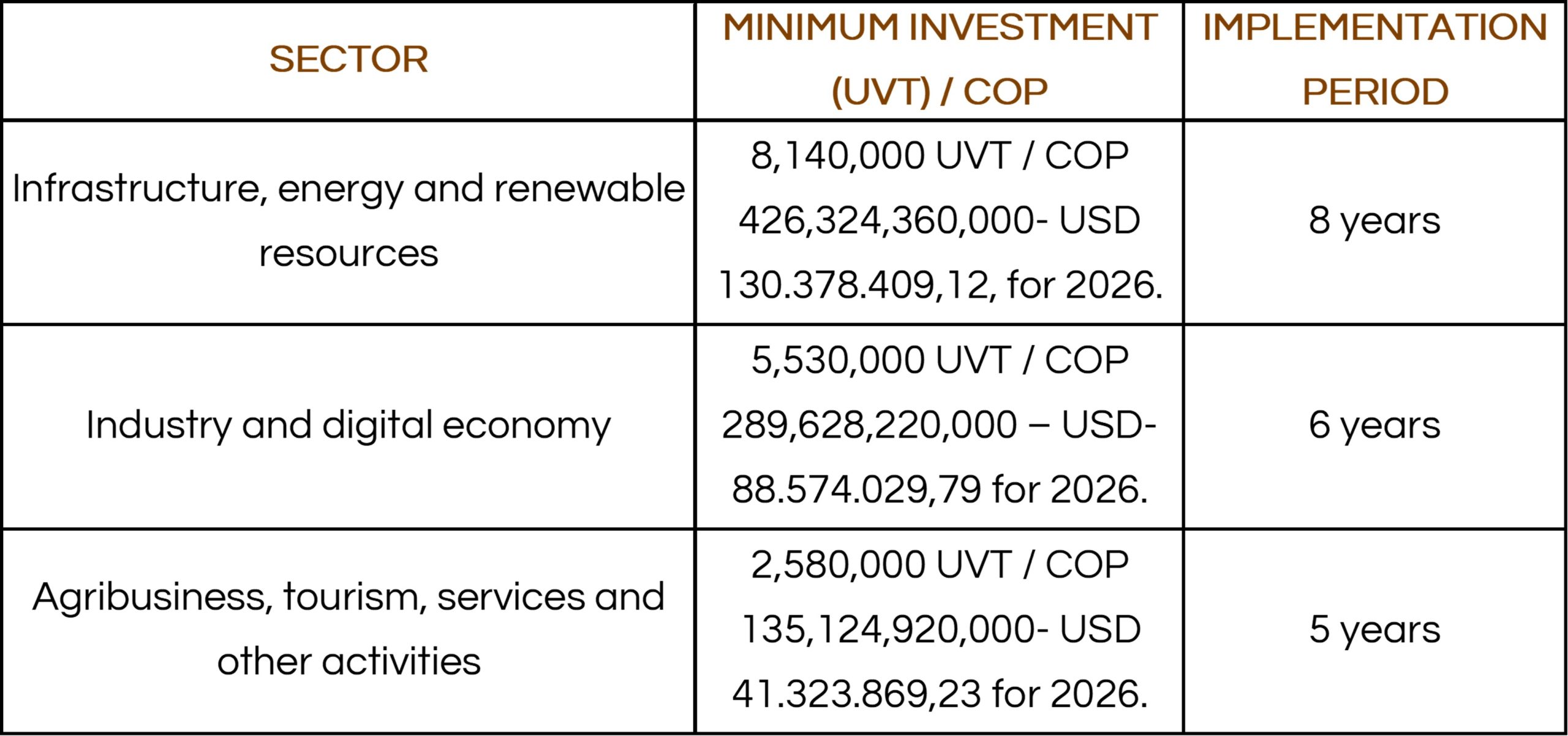
Public-private partnership projects may qualify subject to special conditions.
Unified income tax rate: The rate applying to RUGE projects is determined by the year in which implementation begins and remains in effect throughout the stability period:
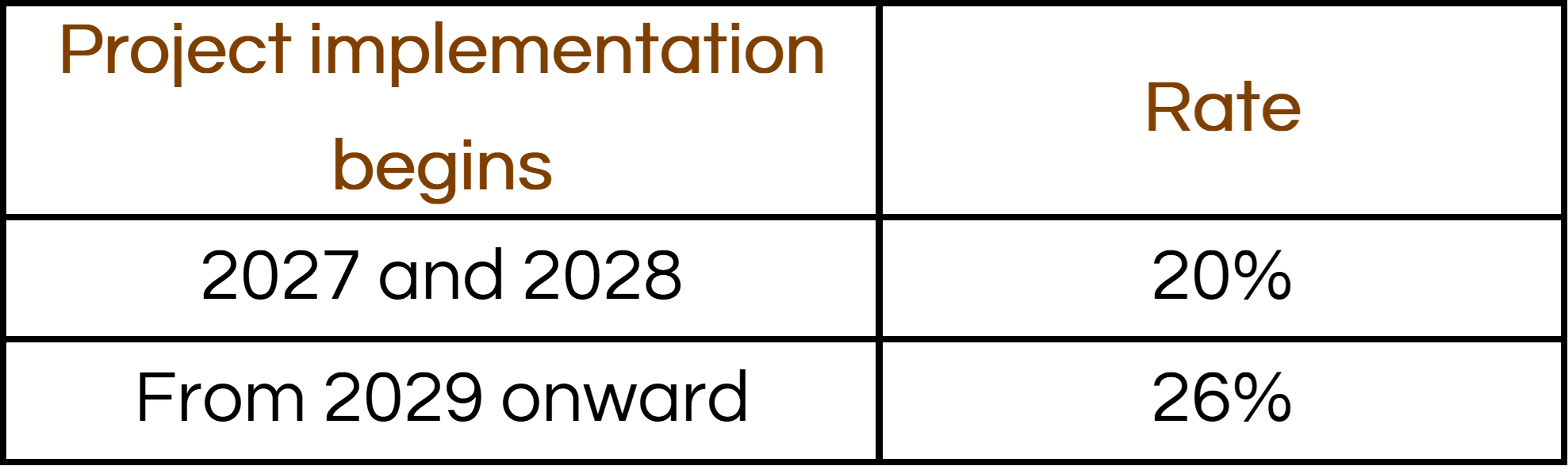
Tax rate on dividends and profit distributions:
Dividends paid out of profits from qualifying projects to nonresident partners or shareholders will be subject to an 8% rate.
For distributions to domestic companies, the 8% withholding tax may be passed through to the ultimate beneficiary, whether a resident individual or a foreign investor, without additional withholding on subsequent distributions. Dividends to resident individuals will be subject to general rates.
Accelerated depreciation:
New investments in depreciable fixed assets, machinery, equipment, networks, and computer and telecommunications equipment may be depreciated at up to 50% per year; buildings and structures may be depreciated at 10% per year.
The adjusted minimum effective tax rate will be calculated without considering the temporary difference arising from this incentive.
Mutually exclusive benefits:
RUGE benefits may not be combined with those available to free trade zones, to investments in ZOMAC (Zonas Más Afectadas por el Conflicto Armado — Areas Most Affected by the Armed Conflict) and ZESE, (Zonas Económicas y Sociales Especiales — Special Economic and Social Zones), to sales of energy from nonconventional sources, or to income associated with social-interest housing (VIS) or priority-interest housing (VIP).
RUGE benefits may not be combined with incentives under Legislative Decree 1413 of 2026 for investments in areas affected by the 2026 earthquake, either.
A RUGE project may not simultaneously qualify as a free trade zone user or a special permanent free trade zone user.
Within three months following the entry into force of the law, the Government may establish temporary tariff treatment for imports of capital goods, machinery, equipment, parts, and spare parts which are not produced locally, and which are intended for qualifying projects.
Legal Stability Regime:
The legal stability regime will last 16 years. During that period, the contracting party may not claim compensation or restoration of the economic balance of the contracts because of amendments to the stabilized rules.
Enrollment in the regime requires the following commitments:
- Implementation: To invest at least 40% of the committed amount within two years after enrollment and 100% within the applicable sector-specific period.
- Domestic supply-chain development: During implementation and the first five years, the qualifying project must source at least 30% of purchases of goods and services from domestic suppliers (excluding land and goods not produced domestically); allocate at least one-third of local purchases to micro, small and medium-sized enterprises or suppliers located in the department where the project is carried out; and implement a regional supplier development plan identifying quality or scale gaps and measures to address them.
- Guarantee: To provide a performance guarantee covering at least 2% of the committed investment.
- Public reporting: To file an annual report on investment executed, purchases from suppliers, progress under the supplier development plan, and direct formal employment.
This bulletin is for informational purposes only and does not constitute legal advice. For specific cases, we recommend obtaining tailored legal counsel before making decisions based on the information provided herein. In compliance with personal data protection regulations, REYES ABOGADOS ASOCIADOS S.A. invites you to contact us if you do not wish to continue receiving our legal updates.